
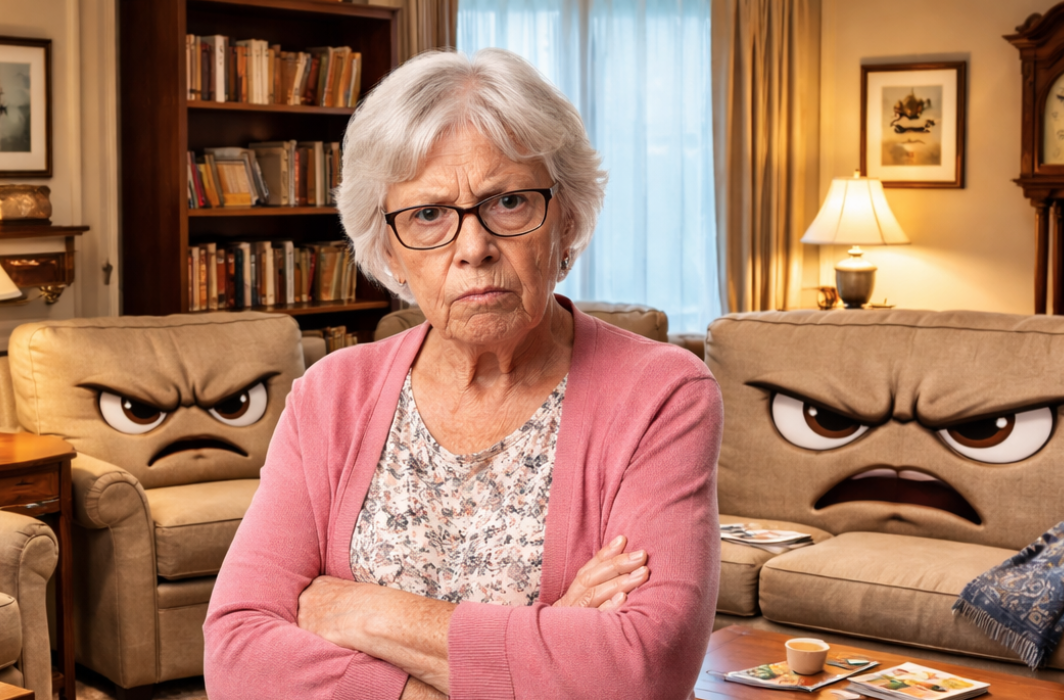
 There is an old saying that we are what we eat. It’s usually meant in a nutritional sense — consume vitality and you radiate vitality; consume junk and you feel like junk. But there is another, quieter truth humming in the background of modern life: we are what we own.
Or more precisely, we become shaped by what we refuse to let go of. Our furniture, our ornaments, our lounge suites and mahogany tables — they begin as objects, and slowly, imperceptibly, they begin to own us.
Walk into a home and you can read it like a biography. The heavy leather recliner positioned like a throne. The glass cabinet of untouched china. The plastic-wrapped “good” sofa no one is allowed to sit on. Each piece carries not just function but hierarchy. It dictates behaviour. It determines tone. It whispers rules: Don’t spill. Don’t touch. Don’t scratch. Don’t jump.
And suddenly the house is not a home but a museum curated by fear.
Materialism rarely announces itself as greed. It disguises itself as pride. As hard work. As “we paid good money for that.” Particularly for many baby boomers — a generation that often equated ownership with security — furniture was proof that you had made it. After decades of mortgage payments, overtime shifts, and careful budgeting, that lounge suite was not just seating. It was validation.
But here is the uncomfortable question: when your grandchild leaps joyfully onto that lounge and your first instinct is rage rather than laughter, who is in charge? You or the upholstery?
A couch is cotton, foam, timber frame, springs. It is an arrangement of matter. It does not care if it is dented. It does not feel dishonoured by muddy socks. It has no emotional attachment to its resale value. Yet humans routinely allow these inanimate configurations of atoms to trigger disproportionate anger. We become protectors of fabric at the expense of flesh.
If a child’s memory of you becomes “Don’t jump on Grandpa’s couch” instead of “Grandpa laughed when we built cushion forts,” what has been preserved? The furniture. And what has been dented? The relationship.
There is something faintly tragic in the spectacle of an adult towering over a small child, voice raised, defending a sectional sofa as though it were a moral principle. In that moment, the hierarchy is inverted. The object has ascended. The human has descended. We become servants to stitching.
Material possessions promise stability. They offer a sense of control in a chaotic world. But they also quietly impose maintenance: polish me, insure me, protect me, worry about me. The more we accumulate, the more mental bandwidth is devoted to safeguarding accumulation. Ownership morphs into obligation. The possessions sit still; we orbit them.
This is not an argument for living without chairs. It is an invitation to notice the power dynamic. When protecting objects becomes more urgent than nurturing people, something has tilted.
There is also a strange metaphysical angle to all of this. On a molecular level, the furniture in your living room is not “dead.” The atoms that compose it — carbon, hydrogen, oxygen, trace metals — are still vibrating. Atomic bonds are dynamic. Electrons move. Wood was once part of a tree drawing sunlight through photosynthesis. The leather once belonged to a breathing animal. Even synthetic fabrics are chains of active molecules formed from ancient hydrocarbons. Matter is not inert in the way we casually imagine; it is energy arranged in patterns.
But activity at the atomic level is not life in the biological sense. Your sofa is not secretly conscious. It does not scheme for dominance. It does not demand reverence. The irony is that while the atoms are lively, the object itself is indifferent. The only consciousness in the room is yours — and your grandchild’s. Yet it is the conscious beings who end up subordinated to the arrangement of unconscious matter.
There is a deeper cultural layer here too. For many in older generations, furniture in Sydney symbolised arrival. It was the opposite of instability. Post-war scarcity shaped a mindset where durability and preservation were virtues.
“Take care of your things” was wise advice. But somewhere along the line, “take care” mutated into “guard obsessively.” The living room became a showroom rather than a playground.
Ask yourself this: when you are gone, what will endure in the minds of your grandchildren? The exact model of your lounge suite? The firmness of its cushions? Or the emotional climate of your home? The warmth. The laughter. The permission to be exuberant.
We like to think we own our possessions because our names are on receipts. But psychologically, the equation can reverse. If your mood is hostage to the condition of your carpet, the carpet has leverage. If your identity depends on the polish of your dining table, the table has authority. That is a subtle form of servitude.
It is also exhausting.
There is freedom in reordering priorities. A couch can be reupholstered.
Timber can be sanded. Even expensive furniture depreciates the moment it enters your home. But childhood memories appreciate over decades. They compound. A single afternoon of building a cushion fortress can echo through a lifetime.
Materialism, at its most insidious, convinces us that preservation equals virtue. Yet life itself is messy. Wood scratches. Fabric fades. Children grow. The irony is that in trying to freeze our surroundings in pristine condition, we often calcify ourselves. We become rigid guardians of objects rather than flexible participants in joy.
None of this demands recklessness. Boundaries are reasonable. Safety matters. But tone matters too. The difference between “Let’s jump outside instead” and “Get off that couch!” is the difference between guidance and tyranny. Between stewardship and servitude.
If atoms are forever in motion, perhaps that is the quiet lesson. Matter flows. Forms change. The tree became timber. The timber became furniture. One day the furniture will decompose or be discarded, its atoms repurposed yet again. Meanwhile, relationships — though intangible — shape neural pathways, emotional patterns, family narratives. Those are also molecular events: synapses firing, hormones releasing, brains wiring in response to tone and touch.
So in a sense, you are what you eat — yes — but you are also what you prioritise. You are what you defend. You are what you elevate. If furniture sits above family in your hierarchy of concern, that hierarchy will be felt.
The question is not whether furniture is alive at a molecular level. It is. All matter hums with energy. The question is whether we are fully alive in the presence of our possessions — or whether we have allowed them to domesticate us into brittle custodians of upholstery.
Perhaps the real inheritance we leave behind is not mahogany but memory. Not leather but laughter. The atoms in your lounge will keep vibrating long after it is gone. The atoms in your grandchildren’s brains are vibrating right now, recording how it feels to be in your house.
Which vibration do you want to amplify?